
Is Fear a Sin?

“Fear not!” “Do not be anxious!” Such imperatives occur over 300 times in Scripture.[1]
Yet if fear is forbidden, does that make it a sin?
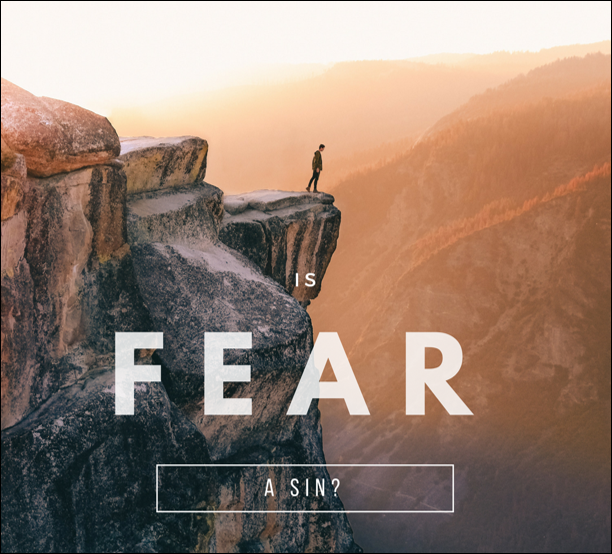
Image by Trisha Keehn
Good Fear
Certainly, there are good kinds of fear. There is the fear of the Lord which is “the beginning of knowledge” (Prov 1:7; 9:10). There is the genuine concern we have for fellow believers (1 Cor 12:24-25). And there is the natural God-given fear we experience when we meet a bear in the woods. Fear quickens our heart rate, increases oxygen output to our muscles, and sends adrenaline coursing through our veins which prepares our body to take action. We don’t need to consciously instruct our brain to do all this because fear is an instinctive physiological reaction. The only decision we must make in the moment is “fight” or “flight,” depending on the size of the bear.
Biblical counselor, Ed Welch, states that fear is not a sin, but a call to active faith.[2] Fear only becomes a problem when left unattended. Fear is natural. It is normal. The Lord even expects it in the believer’s life (Pss 55:4-6; 2 Cor 7:5). Welch defines fear as human weakness. “But weakness is not sin,” he writes, “Weakness means that we need help from God and other people” (Heb 4:15).
Therefore, God’s exhortation should be read like a Good Shepherd comforting his sheep: “Fear not, little flock” (Luke 12:32). These are the words of a loving Father for his precious children: “Are you not of more value than they?” (Matt 6:26). Such truths are spoken with compassion, not condemnation. They are no more a command than, “Do not weep” (Luke 7:13), or, “Take heart, my son” (Matt 9:2).[3] For those who are of “little-faith” must grow in their maturity more than they need repentance (e.g., Luke 17:5). Fear can lead to disobedience (e.g., Num 14; 1 Sam 15:24) or prayerless trust in man (e.g., Hos 7:14; Isa 7:10-12), but fear itself is not a sin.
Counselors, then, should take this same approach of compassionate care instead of laying on guilt for life’s common concerns. Welch offers this gentle corrective to encourage the weak instead of harshly rebuking their anxiety.

Image by Christine Miller
Bad Fear
It also seems, though, that there are times when fear is bad.
Foolish fear merits a rebuke, however gentle: “Why are you afraid, O you of little faith?” (Matt 8:26).
Irrational fear might excuse our laziness: “There is a lion in the streets!” (Prov 26:13).
Fear can steal our time when it is unproductive like a hamster scrambling on a treadwheel (Matt 6:27, 34).
Fear is unnecessary because our God is powerful, compassionate, and absolutely trustworthy (Matt 6:26, 28-30).
Fear can also rend the soul. The Greek word for anxiety (merimnao) stresses the action and effects of sinful fear: “To divide, rip, tear apart, be anxious, distract the attention” (Phil 4:6; Matt 6:27; Mark 4:19). This happens when we are torn between following God’s desires and our own fleshly desires.
Fear is unbecoming of the Christian because it focuses on earthly values, not eternal ones (Matt 6:25)—the gifts and not the Giver. It chases what we do not have and reveals our love for the world (vv. 31-32). It can even be rooted in idolatry since fear is the flipside of desire (v. 24).
Fear can be a sign of spiritual captivity which should not be in our nature as children chosen by God: “For you did not receive the spirit of slavery to fall back into fear, but you have received the Spirit of adoption as sons, by whom we cry, ‘Abba! Father!’” (Rom 8:15).
Fear did not control the life of Christ. For although our Savior was fully tempted by fear and anxiety, he did not succumb to sin (Heb 4:15). Although he experienced an appropriate physiological response to the terrors of the cross, he directed those concerns to God in prayer (Luke 22:41-44).
Fear can indicate a lack of love as John reminds the church, “There is no fear in love, but perfect love casts out fear. For fear has to do with punishment, and whoever fears has not been perfected in love” (1 John 4:18).
Fear can show a lack of faith: “Do not fear; only believe” (Luke 8:50). So, if Jesus tells us, “Do not fear,” and then we fear, “It is a sin.” In fact, it is wise to fear our unbelief in view of God’s severe mercy (Rom 11:20-22). We must tame our fear of man by rightly fearing God (e.g., Matt 10:28; Acts 5:29).
Fear often drives us away from God, instead of to him (e.g., Gen 3:10; Luke 19:21; Jas 2:19). So, in those times, we must repent.
In summary (though admittedly a less-catchy title), fear is not always a sin, but it is always an opportunity to honor Christ and to trust in God.
So, When Do We Cross the Line?
Fear is sometimes commended, but at other times not. For instance, both kinds occur side-by-side in Exodus 20:20, “Moses said to the people, ‘Do not fear [bad], for God has come to test you, that the fear of him [good] may be before you, that you may not sin.’”
Yet we end up crossing the line from natural fear to sinful anxiety when:
All our thoughts are concerned about changing the future. The channel of our thoughts gets stuck on future events which are beyond our scope of responsibility. “Therefore do not be anxious about tomorrow, for tomorrow will be anxious for itself. Sufficient for the day is its own trouble” (Matt 6:34).
Anxiety controls us instead of us controlling it. The Christian receives the spiritual fruit of self-control (Gal 5:22-25). So even when our fears arise, we have courage in Christ to overcome.
We stop functioning in life and neglect our relationships. We cannot love God and neighbor well when we are too focused on ourselves (Matt 22:37-40).
We start losing hope instead of finding answers in the Lord (Lam 3:16-26).
I certainly agree with Welch, though, that fear is a call to action, requiring wisdom in our counsel appropriate to the situation. For this reason, we admonish the sinful, encourage the fainthearted, help the weak, and remain patient with all (1 Thess 5:14). So let us walk in a manner worthy of the calling to which we have been called (Eph 4:1). “For God gave us a spirit not of fear but of power and love and self-control” (2 Tim 1:7).
Here are some helpful resources to study further:
9Marks Counseling Talk (podcast), “On Anxiety” (3-part series).
ACBC Resources, “Anxiety.”
DeCourcy, Philip. Help! I’m Anxious (Shepherd Press, 2018).
Fitzpatrick, Elyse. Overcoming Fear, Worry and Anxiety: Becoming a Woman of Faith and Confidence (Harvest House, 2023).
IBCD Archive, “Worry and Anxiety.”
Jones, Robert. Why Worry? Getting to the Heart of Your Anxiety (P&R, 2018).
Joyful Journey (podcast), “Anxiety and Panic Attacks.”
MacArthur, John. Anxious for Nothing: God’s Cure for the Cares of Your Soul (David C. Cook, 2012).
Mack, Wayne & Joshua. Courage: Fighting Fear with Fear (P&R, 2014).
Powlison, David. Overcoming Anxiety: Relief for Worried People (New Growth, 2008).
Priolo, Lou. Fear: Breaking Its Grip (P&R, 2009).
Scott, Stuart. Anger, Anxiety, and Fear: A Biblical Perspective (Focus, 2009).
Tautges, Paul. Anxiety: Knowing God’s Peace (31-Day Devotionals for Life) (P&R, 2019).
Thorne, Helen. Hope in an Anxious World (Good Book, 2021).
Wallace, Jocelyn. Anxiety and Panic Attacks: Trusting God When You’re Afraid (Faith, 2013).
Weidmann, Josh. The End of Anxiety: The Biblical Prescription for Overcoming Fear, Worry, and Panic (Salem, 2020).
Welch, Ed. Running Scared: Fear, Worry, and the God of Rest (New Growth, 2007).
Welch, Ed. A Small Book for the Anxious Heart (New Growth, 2019).
[1] Although there are slight nuances, this post addresses fear and anxiety as overlapping.
[2] This book expands Welch’s article in JBC 34.1 (2020), 7-19.
[3] In Greek, the imperatival form can also present a request or make an entreaty. For example, we use it to petition in prayer even though we are not commanding God (e.g., “Give us this day our daily bread”).
You should include the first imperative of Hebrews in your discussion,
which is to fear.
see Heb 4:1.